Rationale
At Higham Hill Maktab we believe students behave best when they are motivated, involved, consulted and respected. We build on their intrinsic motivation, in preference to using punishments, threats or rewards. We aim to nurture an ethos of co- operation rather than punishment and control.
Our overriding concern is to do things with students rather than to them. When we have to deny choice, perhaps due to safety or external pressures, we explain our reasons. Students need opportunities to do better and feel good about themselves. We build on their sense of fairness and justice to develop awareness of rights and responsibilities. We believe students who treat others badly need help and guidance. Adults have a responsibility to try to act as role models in building and nurturing a Maktab community.
The Maktab will best achieve its educational aims if codes of conduct are accepted, understood, observed and pursued by all. The overriding aim should be to encourage self- awareness and self-discipline.
Aims
- Encourage relevant, sensitive and constructive interaction between all staff, students and parents;
- Develop and maintain a code of conduct and behaviour understood and accepted by everyone;
- Build a secure, open and stimulating environment that is conducive to teaching and learning of the highest standard;
- Develop in students a sense of self-awareness and sensitivity to others; Endeavour to create a meaningful curriculum which offers choice;
- Encourage students’ participation in decision-making as preparation for taking an active role in society;
- Help students learn to make informed decisions and take responsibility for their words and actions;
- Recognising and praising appropriate behaviour;
- Making clear the consequences of inappropriate behaviour; and Always giving students ‘another chance’.
Teaching and Learning
Staff must be on time to lessons and should greet their classes as they arrive; Lessons should be well structured with a quick pace to avoid periods of inactivity; seating arrangements should promote good behaviour and effective learning.
Out of Class Behaviour
All staff have a responsibility to challenge inappropriate behaviour outside the classroom; If the member of staff does not know the name of the student, they should enlist the help of a senior staff available in identifying the student. Students are much less likely to behave poorly if staff know them or are persistent in identifying them;
Staff must be on time for all duties including break duty.
Staff should be present in the corridors at lesson changeover and help clear the floor at the beginning and end of break and lunch.
Communicating with Parents
The Maktab recognises the value of working in partnership with parents. Staff are encouraged to inform parents of positive behaviour and achievement through phone calls/letters home/face to face meetings.
Staff are encouraged to work with parents to plan behaviour or academic improvements through phone calls/letters home or meetings with parents.
Planning
De bandbreedte van de spellen op https://maxi-spin-nl.com overtuigt door diepgang en doordachte selectie. De live chat maakt directe communicatie met dealers en medespelers mogelijk. De indeling in themacategorieën maakt het makkelijker om snel het juiste spel te vinden. Spelers kunnen indien gewenst hun eigen dag-, week- en maandlimieten configureren. Autoplay-functies maken het mogelijk vooraf gedefinieerde spelroutines voor bepaalde slots in te stellen. De klantenservice gebruikt een intern ticketsysteem, waardoor alle vragen lückenlos gedocumenteerd worden. De filters maken gelijktijdige selectie van meerdere criteria voor gerichte zoekopdrachten mogelijk. De gebruikersinterface past zich automatisch aan de schermgrootte van het apparaat aan. De consistentie in servicekwaliteit pleit voor een serieuze aanbieder.
We attempt to offer choice within the curriculum so that students’ motivation is grasped. We need to make sure that all students have achievable and challenging targets so that they can experience progress and success. Differentiation allows students to have appropriate learning tasks and provides maximum opportunities for success.
Class and whole Maktab assemblies celebrate achievement and effort, and contribute to building the academic community. Parents are welcomed as partners in the education of their students within our vision and aims.
Entitlement
All students are entitled to feel safe and respected at the Maktab. We expect all members of the Maktab community to relate in a courteous manner. We consider all members of the Maktab community to be linked in an endeavor to do our best and to adhere to the Maktab Code of Conduct.
Implementations and Organisation
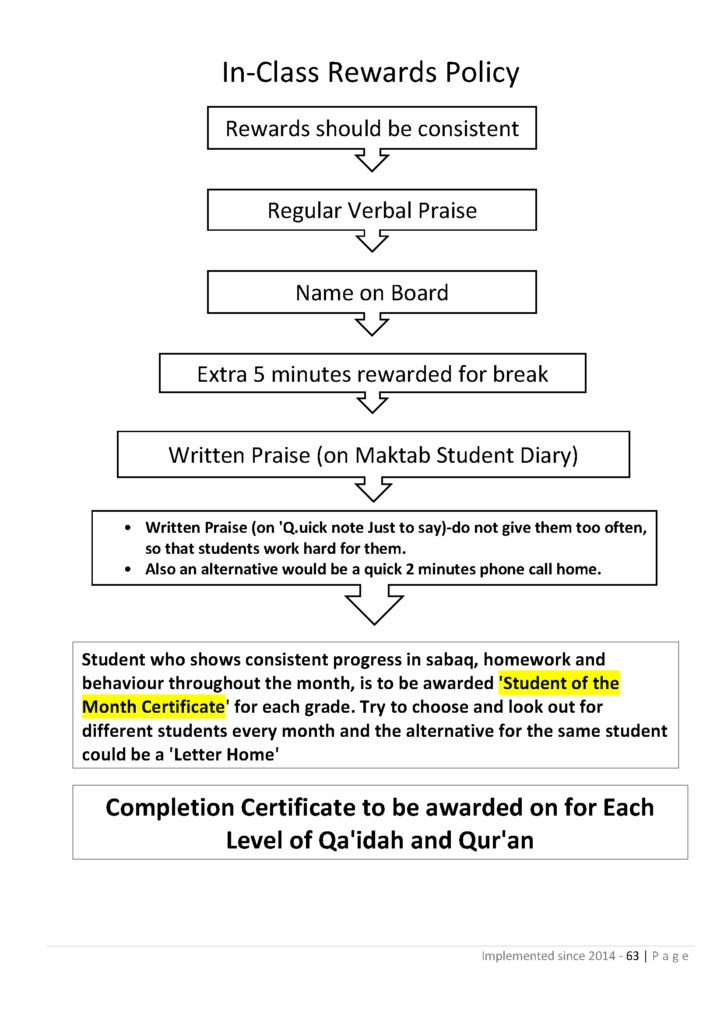
We celebrate and acknowledge community and individual achievement. Genuine and un- patronizing responses are sought, rather than “rewards” such as stickers.
Students are given opportunities to be involved in decision-making and to voice concerns,
e.g. in the Maktab Council and Class Council times. Opportunities are provided for students to talk, listen and be heard.
The main response to students treating others badly is to talk about it with the student. If a student is not completing a task we must reflect on the appropriateness of the task.
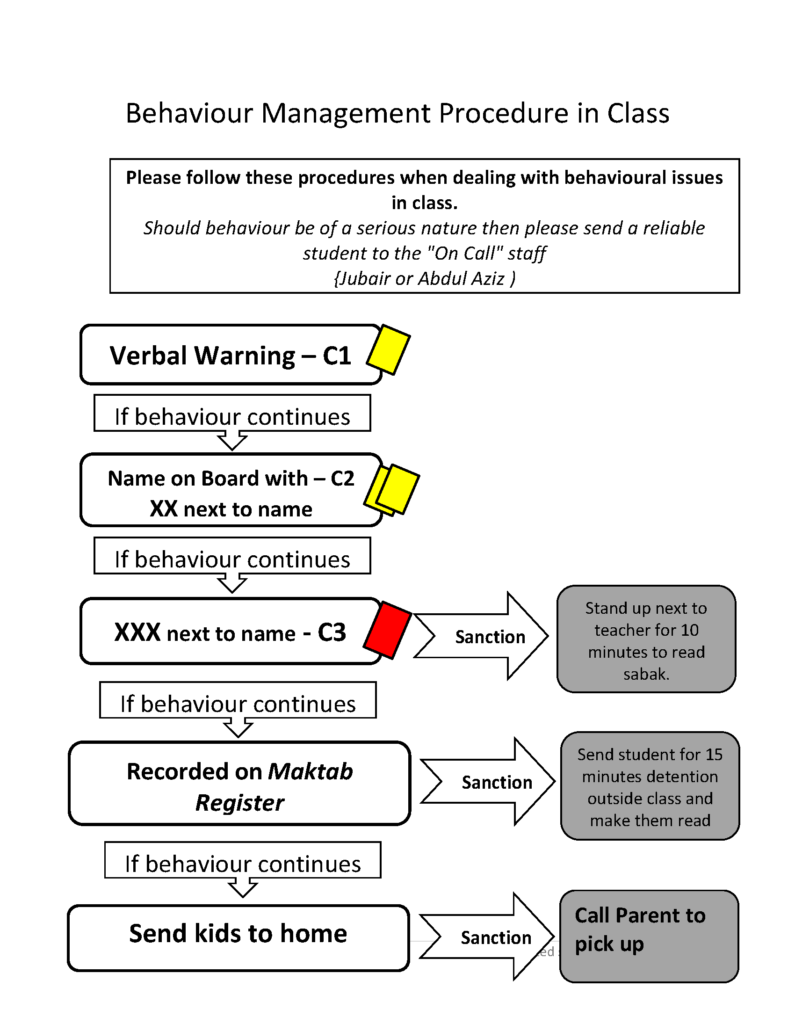
If there are occasions where a student is too disruptive to stay in the classroom they are accompanied to another classroom where they are encouraged to succeed and the ‘Behaviour Management Procedure in Class to be applied with consistency.
A very serious breach of behaviour, e.g. causing physical injury, will result in parents being asked to keep a student at home for some time to talk things over. On a student’s return to class or the Maktab there will be the opportunity for discussions with the student.
Students are not “sent out” to corridors or “outside the office”. Their need to play is fundamental to their development and should be respected, so they are not kept in unnecessarily at break or lunch times.
Roles and Responsibilities Ustadhs:
- To create a positive and co-operative environment within their group;
- To discuss issues of behaviour and choices within their group and with individuals;
- To follow and implement consistently the Behaviour Management policy & the Reward Policy
- To keep parents informed of positive and adverse performance of pupils through the muhasabah diary and also in person
- To inform their line manager, or any other relevant person, of concerns To participate in all pastoral care meetings and activities
- To create a positive and co-operative environment within their group
Line Managers/Senior Teachers:
- To be a presence around the Maktab;
- To ensure that staff carry out their responsibilities;
- To support and advise any member of their staff who is experiencing ongoing difficulty with a particular student/group;
- To support staff in meeting parents;
- To organise the temporary removal of a student while the situation is resolved;
- To ensure good order within their area;
- To inform the Head teacher of any particular student/group causing ongoing difficulty.
- To ensure that the Behaviour Management policy ( & the Reward Policy are implemented equally around the class
Further Development
This policy needs to be used as a basis for discussion with students and staff. We need to investigate other practices which could contribute to our policy.